

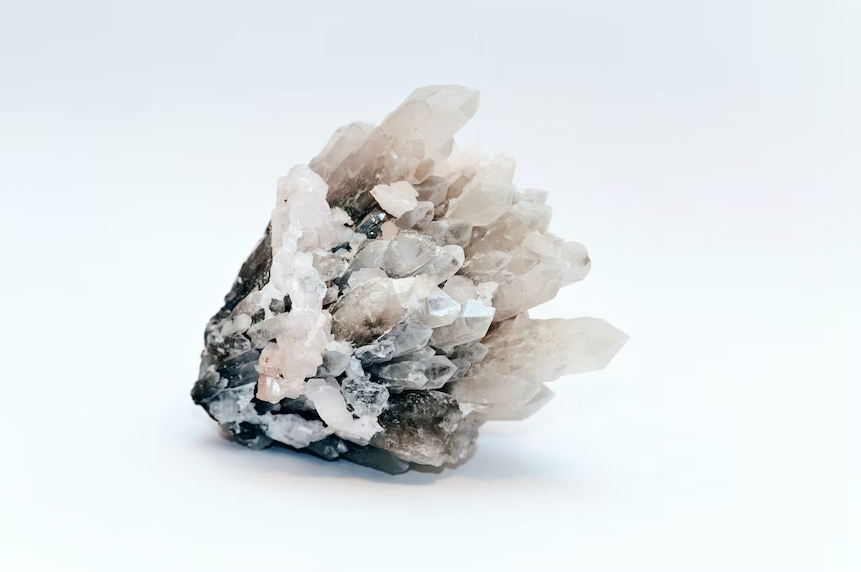
A cluster of white and black crystals on a white background.
Homeowners who want to breathe new life into their kitchens have probably heard about mineral surface benchtops. Thanks to their nearly indestructible nature, attractive appearance, and impressive longevity, these benchtops are all the rage in the kitchen furniture industry.
How Are Zero-Silica Mineral Surfaces Made?
Mineral surface benchtops typically come in large-format slabs that can be cut and shaped according to the homeowner’s needs. Let’s examine how that slab comes to be.
Step 1: Feeding and Mixing
Step 2: Moulding and Pressing
The mixture is poured into a mould to form large slabs and then compressed under high pressure to ensure air pockets are minimised. This creates a dense and uniform surface.
Step 3: Curing
After pressing, the slabs are subjected to heat treatment to solidify and strengthen. This step ensures the finished product is durable enough for various applications.
Step 4: Polishing
Once cured, the slabs are polished to achieve a smooth, attractive surface. This step also allows for a variety of finishes and designs.
Step 5: Quality Testing
Every slab undergoes quality checks to ensure it meets industry standards for durability, consistency, and appearance.
Step 6: Tagging and Distribution
After passing the quality checks, the slabs are labelled and prepared for distribution to ensure they reach customers in perfect condition.
How Is Engineered Stone Made? Traditional Engineered Stone vs. Mineral Surfaces
Traditional engineered stone is made by crushing natural quartz and binding it with polymer resin and pigments. Because quartz is crystalline silica, these slabs could contain more than 90 per cent crystalline silica. Cutting, grinding and polishing those slabs releases fine silica dust, which is why Australia prohibited the manufacture, supply and installation of engineered stone benchtops, panels and slabs from 1 July 2024. Under the prohibition, engineered stone is an artificial product that contains 1 per cent or more crystalline silica.
Zero-silica mineral surfaces follow a similar manufacturing process but replace quartz with other minerals. The key differences are in the raw materials, not the look: a mineral surface can recreate the veining of marble, the speckle of granite or the movement of quartzite while avoiding crystalline silica.
What Goes Into a Mineral Surface Slab?
- Minerals: crushed natural minerals make up most of the slab and give it strength and hardness.
- Resin binders: a polymer resin holds the minerals together and helps create a dense, non-porous surface.
- Pigments: colour pigments create the base colour and veining patterns in each design.
From Slab to Benchtop
After the slabs leave production, a fabricator cuts them to size, shapes the edges and prepares cut-outs for sinks and cooktops. Slab size and thickness affect where seams fall in a kitchen design, and large-format slabs help reduce seams and waste. Choosing a mineral surface also makes fabrication safer, because the material does not contain crystalline silica.
Mineral Surfaces Compared with Other Countertop Materials
Compared with natural stone such as granite and marble, a mineral surface needs little maintenance because it does not require sealing. Compared with porcelain, it is another engineered option with a wide choice of colours and designs. Like any benchtop, it benefits from simple care: use trivets for hot pans, wipe up spills quickly to prevent stains and use a chopping board to avoid scratches. The result is a durable, easy-maintenance surface that balances strength, versatility and aesthetic appeal.
Benefits of Zero-Silica Mineral Surfaces
This manufacturing process provides several key benefits:
- Non-toxic and silica-free: These surfaces contain no crystalline silica, making them a safer choice for both workers and homeowners.
- Durable and non-porous: The dense surface resists stains, heat, and scratches, offering long-lasting performance.
- Low maintenance: Non-porous surfaces require no sealing and are easy to clean.
- Customisable designs: Available in a wide range of colours and patterns to suit various aesthetic preferences.
The Final Step to Greatness
Now that you know how engineered zero-silica mineral surface benchtops are generally made, there’s only one step left – finding a reliable dealer. Enter Quattro Stone.
Quattro Stone is one of Australia’s leading wholesalers of high-quality zero-silica mineral surfaces. The company boasts an impressive collection of slabs, with the eye-catching appearance of natural stone and the strength and resilience of engineered materials.
Although most commonly used for kitchens, these slabs can transform into attractive vanities, tables, reception desks, and more. Reach out to our representatives to take your home or business’s décor to the next level.